
Enabling the AI Revolution via Hardware-Software Co-Design
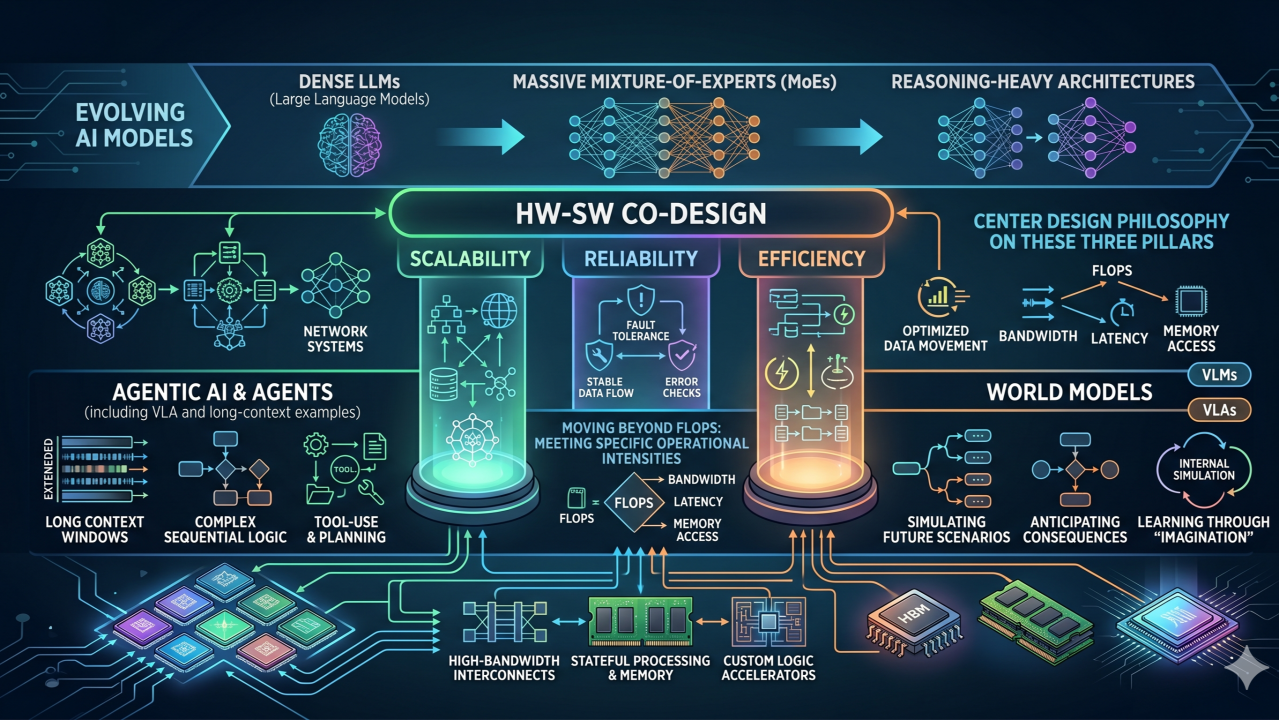
Deployment of Large Language Models (LLMs), Vision-Language Models (VLMs), and Vision-Language-Action (VLA) architectures has fundamentally reshaped the computational landscape. As model parameter counts scale into the trillions, hardware architecture has been forced into an aggressive, continuous evolutionary trajectory. A cross-analysis of successive hardware generations reveals that the performance frontier is no longer about raw compute—it’s dictated by a complex interplay between computational density, memory bandwidth, and interconnect topology. This overview cuts through the hype of theoretical designs and focuses exclusively on architectural innovations and software frameworks that have actively materialized in production systems.
Architectural Evolution
The NVIDIA Trajectory
The progression from NVIDIA’s Ampere to Hopper (H100) and subsequently to the Blackwell (B200/GB200) platform illustrates an industry-wide shift toward accelerating mixed-precision matrix multiplications over general-purpose flexibility. The Hopper architecture pushed boundaries by introducing the first-generation Transformer Engine, which dynamically adjusted precision to support FP8 formats, effectively doubling computational throughput over the Ampere generation.
However, the transition to Blackwell exposed a critical paradigm shift: asymmetric hardware scaling. Blackwell doubles effective precision again by introducing FP4 support. Yet, this unprecedented increase in Tensor Core computational capacity vastly outpaces the scaling of other functional units, like shared memory bandwidth and specialized exponential calculation units (SFUs). Operations that were compute-bound on Hopper have abruptly shifted to become memory-bound on Blackwell. This reality mandates radical software adaptations, such as software-emulated exponential calculations and utilizing 2-CTA Matrix-Multiply-Accumulate (MMA) modes to reduce shared memory traffic.
The Google TPU Trajectory
Google’s Tensor Processing Unit (TPU) evolution diverges from general-purpose GPUs by prioritizing massive-scale interconnects and, more recently, workload-specific bifurcation. Early breakthroughs began with the TPU v4, which introduced Optical Circuit Switches (OCSes) to dynamically alter interconnect topologies (like forming a twisted 3D torus) based on parallelism demands, and integrated SparseCores to bypass standard memory bottlenecks for embedding operations. Recent generations have bifurcated: the TPU v5e focuses on cost-efficient inference, while the v5p scales up for massive foundational model training. The TPU v7 (Ironwood) is defined fundamentally as an “inference-first” architecture, incorporating up to 192GB of HBM to support massive Key-Value (KV) caches, directly countering the generative AI memory wall.
The dawn of the “Agentic Era” mandated a radical shift. Earlier this week, Google announced the 8th-generation TPU family, marking the end of generic AI silicon by introducing two fundamentally distinct architectures:
- TPU 8t (Training): Designed as a high-throughput powerhouse for massive foundational models, the 8t utilizes native FP4 precision to double Matrix Multiply Unit (MXU) throughput while preserving bandwidth. Scaling is its defining feature; via the Virgo Network and optical switching, up to 9,600 TPU 8t chips can form a single superpod.
- TPU 8i (Inference): Recognizing that real-time AI agents (like Mixture-of-Experts) demand ultra-low latency, the 8i discards the SparseCore entirely in favor of a specialized Collectives Acceleration Engine (CAE). To break the “memory wall” of autoregressive decoding, the TPU 8i drastically triples its on-chip SRAM to 384MB and pairs it with 288GB of HBM, ensuring that a model’s active working set—particularly massive KV caches—can remain entirely resident on-chip. To reduce the lag of MoE token shuffling, it utilizes a novel “Boardfly” network topology to connect 1,152 chips in a pod, slashing the maximum network diameter by over 50%.
Timeline View
2020 : NVIDIA Ampere              : NVLink 3.0 (600 GB/s)
2021 : Cerebras WSE-2             : 20 PB/s SRAM Wafer-Scale
2022 : NVIDIA Hopper              : NVLink 4.0 (900 GB/s) & TMA
2023 : Google TPU v4/v5e          : Optical Switches & CXL
2024 : NVIDIA Blackwell           : NVLink 5.0 (1.8 TB/s)
     : Groq & Cerebras WSE-3      : SRAM ASIC / 125 PFLOPS
2025 : Google TPU v7              : 192GB HBM3e (7.4 TB/s)
2026 : Google TPU 8-Series        : Workload Bifurcation (8t/8i), Boardfly Topology, & Virgo Network
     : NVIDIA Vera Rubin + Groq 3 : GPU-LPU dual-stack hybrid architecture
     : Taalas HC1                 : Hardwired AI Weights
Distributed Training
Training modern foundational models requires orchestrating tens of thousands of accelerators for continuous months. This pops up severe, systemic bottlenecks.
Fault Tolerance at the Exascale
In clusters exceeding 10,000 GPUs, the statistical probability of hardware failure becomes the primary bottleneck. During the pre-training of Meta’s LLaMA-3 405B, the system experienced 466 job interruptions in 54 days—half of which were hardware-induced (refer to Table 5 on page 13 of the paper). Traditional checkpointing fails catastrophically when a node dies. Frameworks like Elastor now utilize partition-agnostic checkpointing via fine-grained tensor splits, allowing training to dynamically resume on a shrinking cluster without massive manual recalculations.
The Communication Bottleneck
As models grow, memory demands force the adoption of 4D parallelism strategies (Tensor, Pipeline, Data, and Sequence/Context). However, this inherently trades compute bottlenecks for network bottlenecks. Standard implementations, such as NVIDIA’s Megatron-LM, push traditional cluster networks to their limits. To fight this, holistic approaches like the Fire-Flyer AI-HPC architecture have emerged, utilizing software-hardware co-design—including customized network topologies, specialized communication libraries like HFReduce, and the 3FS distributed file system—to slash communication overhead and maintain high throughput without the premium cost of top-tier hardware. At the scheduling level, systems like WeiPipe orchestrate automated schedules that overlap communication with computation, hiding network latency behind matrix multiplications.
Mixture-of-Experts (MoE) architectures drastically improve parameter efficiency but introduce the “MoE Performance Paradox.” If tokens are routed to experts across different physical nodes, the massive all-to-all network shuffle destroys efficiency gains. To overcome this, highly optimized routing engines like Microsoft’s Tutel provide dynamic scheduling and custom all-to-all algorithms to accelerate expert dispatch. At a cluster scale, production systems like MegaScale-MoE customize parallelism strategies for attention and expert layers, employing fine-grained intra-operator overlapping to comprehensively hide communication latency. Hybrid architectures like DeepSpeed-MoE and dynamic load balancers further mitigate this by grouping tokens that share critical data paths.
Furthermore, Embodied AI and Multimodal models face unique pacing issues due to high-resolution images and varied sensor data. Traditional padding wastes massive computational cycles. By combining variable-length FlashAttention with aggressive Data Packing techniques, researchers have been able to drastically boost training speeds for Vision-Language-Action models.
Inference
While training is generally compute-bound, inference—particularly autoregressive decoding—is severely memory-bandwidth bound. Several optimizations have been proposed in recent years to this end.
The KV Cache and Disaggregation
During text generation, LLMs cache the Key and Value (KV) states of all prior tokens. Moving this massive cache from HBM to the Tensor Cores is the primary inference bottleneck. The vLLM framework revolutionized this via PagedAttention, an OS-inspired algorithm that maps the KV cache into non-contiguous physical blocks, eliminating memory fragmentation and drastically boosting throughput. New approaches, such as SwiftKV, rewrite the model architecture to skip computing the KV cache for later transformer layers entirely when dealing with massive prompt lengths.
LLM inference consists of two conflicting phases: the highly parallel prefill (processing the prompt) and the highly sequential decode (generating the answer). When colocated, massive prefill requests starve ongoing decodes, causing latency spikes. To eliminate this, frameworks such as DistServe physically disaggregate the phases, executing prefills on one set of GPUs and decodes on another. This physical separation allows operators to optimize the prefill GPUs strictly for Time-to-First-Token (TTFT) and the decode GPUs strictly for Time-Per-Output-Token (TPOT), scaling resource allocation independently to meet tight Service Level Objectives.
Alternatively, frameworks like SARATHI tackle TPOT variance without physical disaggregation through sophisticated computational multiplexing. By segmenting massive, compute-heavy prefill requests into smaller chunks and bundling them alongside ongoing decode operations within the exact same batch, they prevent the memory-bandwidth-bound decode tokens from being starved, entirely stabilizing the TPOT and providing massive improvements in continuous throughput.
Attention Overheads and Low-Bit Communication
As sequences grow, IO overhead eclipses floating-point math. While earlier iterations of FlashAttention addressed standard IO limits, the transition to Blackwell required FlashAttention-4 to specifically address asymmetric hardware scaling by relying heavily on thread-block sharing and software emulation.
Finally, Tensor Parallelism requires constant inter-GPU communication, which degrades Time-to-First-Token (TTFT) during inference. Advanced compression frameworks like FlashCommunication utilize dynamic bit-splitting and spike-reserving algorithms to aggressively compress network payloads over NVLink, cutting latency without sacrificing generative accuracy. For multimodal serving, frameworks such as RServe are creating complex pipelines to hide the severe PCIe latency penalty of moving high-dimensional image embeddings behind ongoing LLM decodes.
If you are an AI systems engineer, compiler writer, or infrastructure lead, the mandate is clear: monolithic processing and generic performance gains are dead. The future belongs to granular disaggregation, hyper-specialized network routing, and aggressive hardware-software co-design.
Appendix
This section provides deeper technical context for some of the concepts mentioned earlier in the post.
2-CTA Matrix-Multiply-Accumulate (MMA)
A hardware-level execution mode introduced in NVIDIA’s Blackwell architecture to address asymmetric scaling (where Tensor Core speeds vastly outpace shared memory bandwidth). Rather than individual thread blocks (CTAs) operating independently, 2-CTA MMA allows two adjacent Streaming Multiprocessors to collaboratively execute a matrix multiplication by sharing an operand (like the “B” matrix). This halves the shared memory traffic and drastically reduces atomic operations, preventing the Tensor Cores from being starved of data.
Emulating Complex Math in Software
Basic AI matrix multiplications are incredibly fast, but “transcendental” math functions (like exponentials for Softmax) are handled by smaller, slower Special Function Units (SFUs). As AI accelerators evolve asymmetrically, these SFUs become severe bottlenecks. Engineers bypass them by emulating complex math in software using faster matrix core units—leveraging techniques such as Minimax Polynomial Approximations, Cody-Waite Range Reduction, Horner’s Method, and Piecewise Linear Approximation to calculate non-linear curves almost instantaneously.
Bit-Splitting and Spike-Reserving Algorithms
Techniques used to enable extreme low-bit compression of data payloads over GPU networks (like NVLink) to accelerate Tensor Parallelism, prominently featured in the FlashCommunication framework.
- Bit-Splitting: Standard hardware struggles to process irregular bit-widths (like 5-bit). This algorithm decomposes irregular formats into hardware-compatible units (e.g., separating 5-bit into a fast 4-bit chunk and an independent 1-bit chunk).
- Spike-Reserving: When compressing data down to 2-bit formats, extreme outliers (“spikes”) cause massive quantization errors. This algorithm extracts these extreme minima and maxima, stores them separately in higher precision, and heavily compresses the remaining tight cluster of values safely.
Numerics
In the context of AI hardware, numerics refers to the data formats used to represent model weights and activations. Historically reliant on 16-bit or 32-bit floating-point precision, the industry has aggressively shifted toward ultra-low, sub-8-bit precision formats to alleviate severe memory bandwidth bottlenecks and exponentially multiply the raw computational throughput of Tensor Cores.
- Microscaling Formats (MX): Standardized by the OCP Microscaling Formats Alliance, formats like MXFP6 and MXFP4 achieve extreme memory compression via hardware-level block scaling. Instead of each individual number maintaining its own full mathematical scale, the hardware groups elements together (e.g., 32 MXFP6 elements) to share a single, unified 8-bit scaling factor. This shared exponent shifts the entire block into the correct numerical magnitude, drastically reducing the overall memory footprint while preserving accuracy over a wide dynamic range.
- NVFP4 vs. MXFP4: While the Blackwell architecture supports standard FP4, NVIDIA deployed a proprietary format known as NVFP4 to gain an edge in accuracy. Unlike standard MXFP4 which groups 32 elements together, NVFP4 tightens this grouping to just 16 elements sharing a fine-grained scale (backed by a secondary FP32 scalar). Scaling smaller clusters allows the format to adapt much more locally to the data’s dynamic range. This cuts rounding errors significantly, yielding accuracy that closely rivals 8-bit formats while delivering 1.5x more dense compute throughput than standard chips.
- Perplexity Inversion: While lower precision is universally desired for speed, the transition is not seamless. Recent research has uncovered a “perplexity inversion” phenomenon, an effect where utilizing finer-grained quantization scales can actually harm the mathematical representation of low-magnitude blocks. This challenges the foundational assumption that simply shrinking precision boundaries will always scale efficiently without algorithmic consequences.